

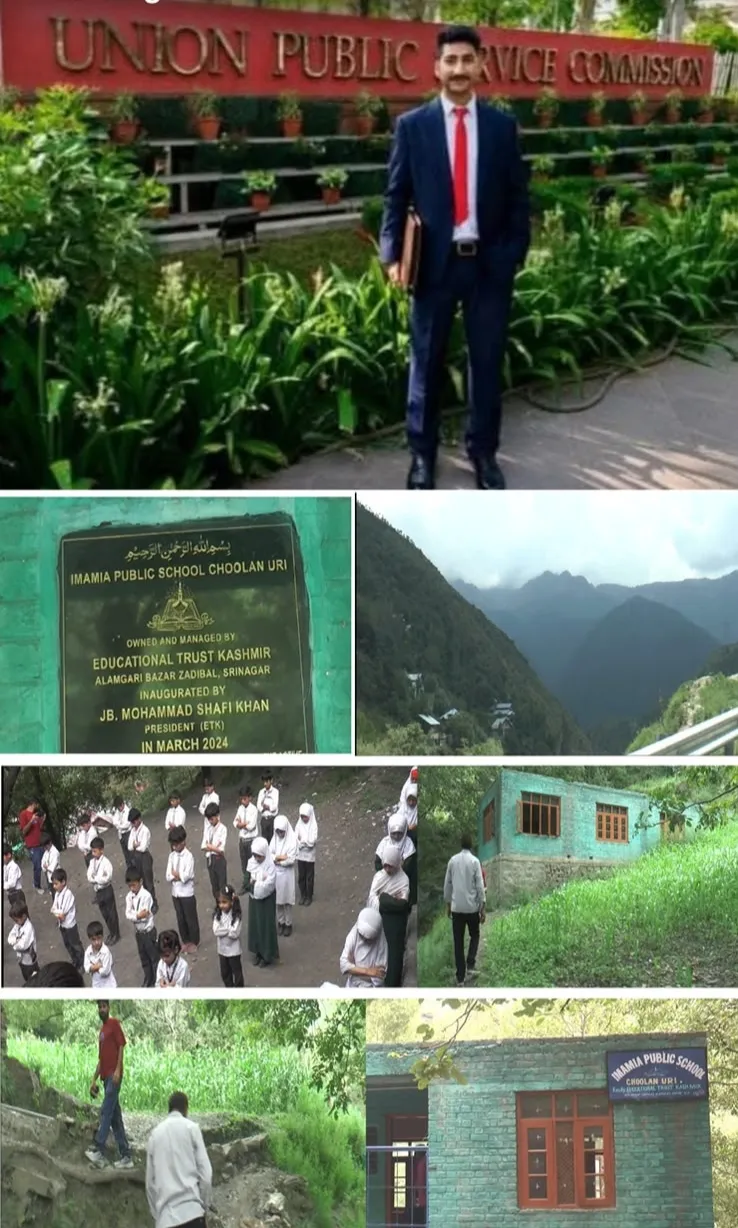
Where Roads End, Education Begins ETK Imamia Public schools in remote border areas of Uri turning geographical isolation into opportunities—Adil Mir crack UPSC.
Syed Abid Gowhar
Reaching the far-flung border areas of Uri in Baramulla district is itself a demanding journey. Establishing and sustaining educational institutions in such difficult terrain is an even greater achievement.
Educational Trust Kashmir (ETK) has been running three Imamia Public Schools in the Uri region—two up to the primary level and one up to the secondary level. These schools serve children living in remote villages where distance, difficult terrain, poor road connectivity and limited educational opportunities continue to shape everyday life.
The presence of these schools in a sensitive border region reflects more than an expansion of the Trust’s educational network. It represents a sustained commitment to taking education to communities that are often separated from major towns by long distances, mountains and inadequate infrastructure.
Among these institutions is Imamia Public School Cholan, situated in a remote village nearly 130 kilometres from Srinagar. The journey to the school presents a reality that is difficult to understand without witnessing it personally.
The village has no proper road connectivity leading to the school—not even a comfortable footpath. The approach passes through steep hilly terrain and clusters of closely built houses. Every step requires care and effort. In Cholan, every footstep appears to create its own path.
At the top of the hill stands the concrete building of Imamia Public School Cholan, inaugurated in 2024. The school serves a village comprising nearly 150 households. Its location may be difficult to access, but its presence has brought education closer to children who might otherwise have remained deprived of organised schooling.
The daily journey of the students is itself a lesson in courage. Before they enter their classrooms, they have to negotiate difficult slopes and unsafe pathways. For these children, going to school is not an ordinary routine. It is a daily expression of determination. Speaking mostly the Pahari language, the villagers gather around any well dressed stranger in assuming him as any government official with some government aid amd relief.
ETK has done commendable work by establishing Imamia Public Schools in remote, hilly and far-flung areas, bringing the light of education to communities that remain difficult to reach. Transporting construction material to such locations, where even walking is arduous and exhausting, reflects ETK’s extraordinary commitment, determination and service to these underserved communities.A school in a remote village is not merely a building containing classrooms. It is often the first institution that introduces a child to a larger world of possibilities. It gives children the confidence to imagine a future beyond geographical isolation and economic hardship.
Yet the true significance of such schools become clearer when the stories emerging from them begin to influence society beyond the villages in which they were founded. One such inspiring story is that of Adil Mir, an alumnus of Imamia Public School Noorkhah Uri.
Adil belongs to Noorkhah village in Boniyar tehsil of Baramulla district. He recently qualified the Central Armed Police Forces Assistant Commandant Examination 2025, securing All India Rank 278.
His journey began in the classrooms of IPS Noorkhah, where he studied up to the eighth standard. It was there that the foundation of his education, discipline and confidence was laid.
Adil’s achievement is remarkable not only because he succeeded in a highly competitive national-level examination, but also because of the hardships he faced during childhood.
When he was studying in the second standard, his father passed away. The loss could have brought his education to an abrupt end. However, the school and its teachers stood beside him at a time when he needed support most.
He was provided free education up to the eighth standard. No school fee was charged from him. Adil remembers that even when he brought money from home to pay printing charges, his teachers would return it.
These were not merely acts of financial assistance. They were acts of compassion that protected the educational future of a child during one of the most difficult periods of his life.
After completing his education at IPS Noorkhah, Adil continued his studies at Noor-ul-Uloom and later completed his higher secondary education. He pursued an Honours degree in Political Science from Aligarh Muslim University and subsequently completed his master’s degree through IGNOU.
Alongside his studies, he continued preparing for competitive examinations. Through perseverance, the guidance of his teachers and the support of his mentors, he succeeded in achieving a goal that once may have appeared distant.
Adil does not describe the success as his achievement alone. He considers it an achievement of Educational Trust Kashmir, Imamia Public Schools and the entire community that supported his educational journey.
The difficult climb towards IPS Cholan and the inspiring journey of Adil Mir are part of the same story.
At Cholan, children walk through steep terrain to reach their classrooms. At Noorkhah, a child who lost his father received the support of his school, continued his education and eventually succeeded at the national level.
The children studying in Cholan and the other ETK schools in Uri today may become the officers, teachers, scholars, writers, administrators and community leaders of tomorrow. Adil’s success shows that talent exists even in the remotest villages. What children need is access, encouragement and sustained institutional support.
The teachers working in these schools are serving in areas where facilities are limited and travelling is difficult. Their role goes beyond classroom instruction. They serve as mentors, guides and, in many cases, the strongest source of encouragement available to their students.
At the same time, the condition of access to IPS Cholan requires the attention of the administration. Children and teachers deserve a safe pathway and proper road connectivity. Establishing a school is a major achievement, but ensuring a secure and dignified route to that school is equally important.
Educational Trust Kashmir’s presence in Uri demonstrates what determined social service can accomplish. Reaching the border region, establishing three schools and continuing to educate children despite geographical and logistical challenges is itself an achievement.
When students from these institutions rise above hardship and earn recognition at the national level, the service becomes even more meaningful.
Adil Mir’s journey is therefore not only a personal success story. It is a reminder of the power of timely support, dedicated teachers and accessible education.
From the steep hill of Cholan to the national achievement of an alumnus from Noorkhah, one message emerges clearly:
Where roads end, education can still begin. Where opportunities appear limited, committed institutions can create new paths. And where a child receives guidance, dignity and support, even the most distant dream can become achievable.
(Author is a senior freelance writer, ace broadcaster and social activist)
About The Author



Comment List